
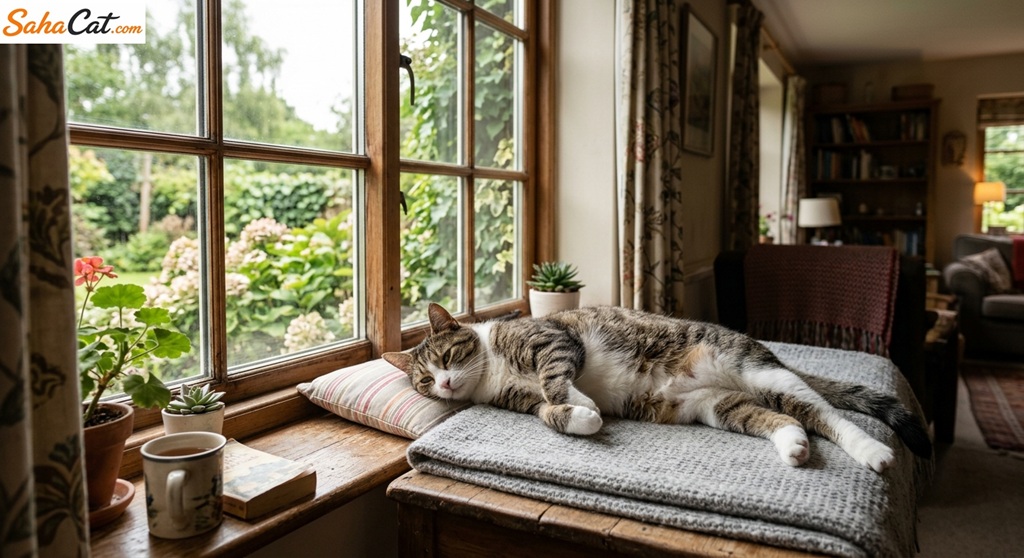
A common assumption is that cats need a large house to be happy. It sounds logical: more rooms, more floor space, more places to explore.
But cats don’t experience a home exactly the way people do. A cat can live very comfortably in a relatively small apartment if the space provides safe resting places, opportunities to climb, appropriate scratching areas, play, and access to its essential resources. This isn’t just general veterinary intuition — the AAFP and ISFM’s Feline Environmental Needs Guidelines, the standard reference veterinarians use for feline wellbeing, organize a cat’s actual needs into five categories, and square footage isn’t one of them: a safe place to retreat to, multiple separated key resources, opportunities for predatory-style play, positive interaction with people, and an environment that respects a cat’s sense of smell. Veterinary guidance also notes that cats can make good use of both horizontal and vertical space, allowing many cats to thrive in smaller homes.
At the same time, a large house isn’t automatically better.

A big home can provide more territory, but it can also create challenges: resources may be spread too far apart, a cat can hide in difficult-to-reach places, and multi-cat households may need to provide resources in several locations.
So the better question isn’t:
“Is an apartment or a house better for a cat?”
It’s:
“How well does this home meet my cat’s physical, behavioral, and environmental needs?”
Apartment vs. Large House: The Real Difference
Here’s the simplest way to think about it:
| Factor | Apartment | Large house |
|---|---|---|
| Floor space | Limited | Usually abundant |
| Vertical space | Particularly valuable | Still important |
| Exercise | Requires deliberate enrichment | More opportunities to move around |
| Resource placement | Needs careful planning | Resources can be distributed |
| Hiding places | Easy to create | Usually plentiful |
| Multi-cat living | Requires efficient organization | More territory can help |
| Safety | Windows, balconies, doors need attention | More rooms and hazards to manage |
| Outdoor access | Often limited | May be easier, but outdoor access isn’t required |
| Main challenge | Making limited space stimulating | Making a large space safe and resource-rich |
Neither home wins automatically.
The quality of the environment matters more than the number of rooms.
Can a Cat Be Happy in an Apartment?
Yes.
A small home doesn’t automatically mean a poor quality of life for a cat.
Cats are remarkably good at using vertical territory. Shelves, cat trees, window perches, climbing structures, and elevated resting places can effectively increase the usable area of an apartment without increasing its floor space. Veterinary guidance specifically recommends vertical spaces because they provide opportunities for climbing, exercise, observation, retreat, and enrichment.
Think of your apartment in three dimensions rather than two.
Instead of asking:
“How much floor space does my cat have?”
ask:
“How many useful places does my cat have to climb, rest, hide, observe, scratch, play, and move between?”
That is a much more useful measurement.
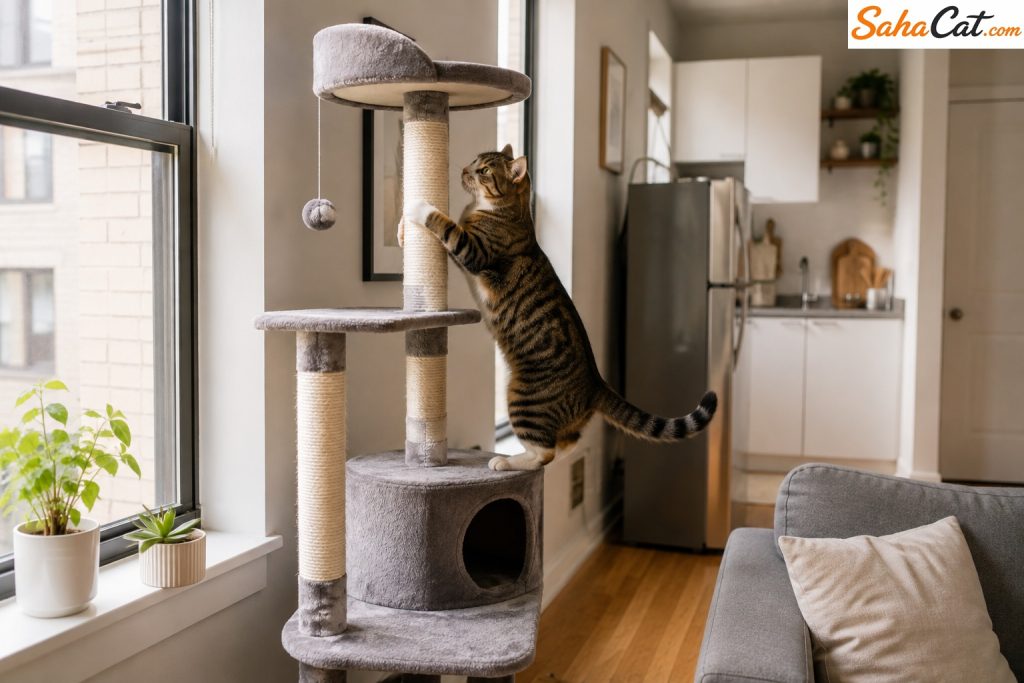
The Secret Weapon of Apartment Cat Care: Vertical Space
If you have limited floor space, look upward.
A sturdy cat tree can give your cat:
- A high resting position
- A climbing route
- A scratching area
- A place to observe the room
- A retreat from people or other pets
- Additional opportunities for exercise
Wall-mounted shelves can provide another climbing route, provided they are securely installed and appropriate for your cat’s size and weight. Window perches can also provide a raised resting area and an interesting view.
You don’t need to turn your apartment into an elaborate cat playground.
Even a few strategically chosen elevated areas can make a significant difference.
But safety comes first
Any tall cat tree or wall-mounted structure needs to be stable.
A cat shouldn’t have to choose between enrichment and falling furniture.
Secure tall structures appropriately and check them regularly for loose components.
Why Windows Matter More in an Apartment
An indoor cat may spend a surprising amount of time observing the world outside.
A secure window perch can provide visual stimulation from:
- Birds
- People
- Trees
- Weather
- Passing animals
- Outdoor activity
This doesn’t replace active play, but it gives your cat something interesting to observe during quiet periods. It’s worth knowing this can cut both ways for some cats: watching an outdoor animal she has no way to reach can build genuine frustration, particularly in territorial or high-prey-drive cats, and is a known trigger for redirected aggression — where that arousal gets aimed at the nearest person or housemate cat instead. This doesn’t mean removing window access, just paying attention to whether your specific cat seems settled or wound up after an intense watching session.

Important apartment safety check
If your cat has access to windows, make sure they are properly secured.
An open window that appears harmless to you can become a fall or escape hazard for a curious cat — and it’s worth naming exactly what that risk is rather than leaving it vague. Veterinarians call it high-rise syndrome: the traumatic injuries cats sustain falling from height, typically the second floor or higher, usually from a window, balcony, or fire escape. Cats don’t jump from dangerous heights on purpose — most falls happen when a cat leans against a loose or improperly secured screen, gets startled, or lunges after a bird or insect and misjudges the distance. Falls are more common in younger cats and spike in warm weather, when windows are more likely left open. With prompt veterinary care, the survival rate is around 90% — but that statistic depends specifically on “prompt care,” and a cat who’s fallen needs a vet visit even if she looks completely fine afterward, since cats are notoriously good at hiding pain and internal injuries aren’t visible from the outside.
The same applies to balconies.
A balcony should never be treated as automatically safe simply because your cat has never tried to jump or climb. Snug, properly secured screens — not childproof window guards, which aren’t designed for this — and keeping windows only cracked rather than fully open when you’re not home to supervise are the two most effective, low-cost preventive steps.
What a Large House Gives You
A large house has an obvious advantage: space.
You may be able to provide several distinct areas for different activities. For example:
- Living room: social interaction and play
- Bedroom: quiet sleeping area
- Window area: observation perch
- Hallway: climbing or movement route
- Separate room: quiet retreat
- Several locations: scratching and litter resources
This can be particularly useful in multi-cat households because cats may need access to separated resources and places where they can avoid one another when necessary.
But there’s an important catch.
More space doesn’t automatically mean more usable space. And if that extra space comes with easier outdoor access — a yard visible through a back door, a garage, screened porches — it’s worth knowing that trades into a real, measurable difference in life expectancy: outdoor cats face meaningfully more risk from traffic, disease, and injury than strictly indoor cats. Our guide to cat lifespan covers this in more depth.
A Big House Can Still Be Boring
Imagine a large house with:
- No scratching posts
- No climbing opportunities
- Few toys
- No interesting views
- No hiding places
- Food and water always in the same location
- Little interaction with the family
Your cat has plenty of square footage. But not much to do.
Now imagine a smaller apartment containing:
- A stable cat tree
- A window perch
- Several scratching surfaces
- Hiding places
- Interactive play
- Puzzle feeding
- Comfortable resting areas
- Predictable interaction with its people
The smaller home may provide a much richer environment. Indoor enrichment should allow cats to express natural behaviors such as hunting, playing, exploring, climbing, hiding, and resting.
Space is an ingredient. It isn’t the entire recipe.
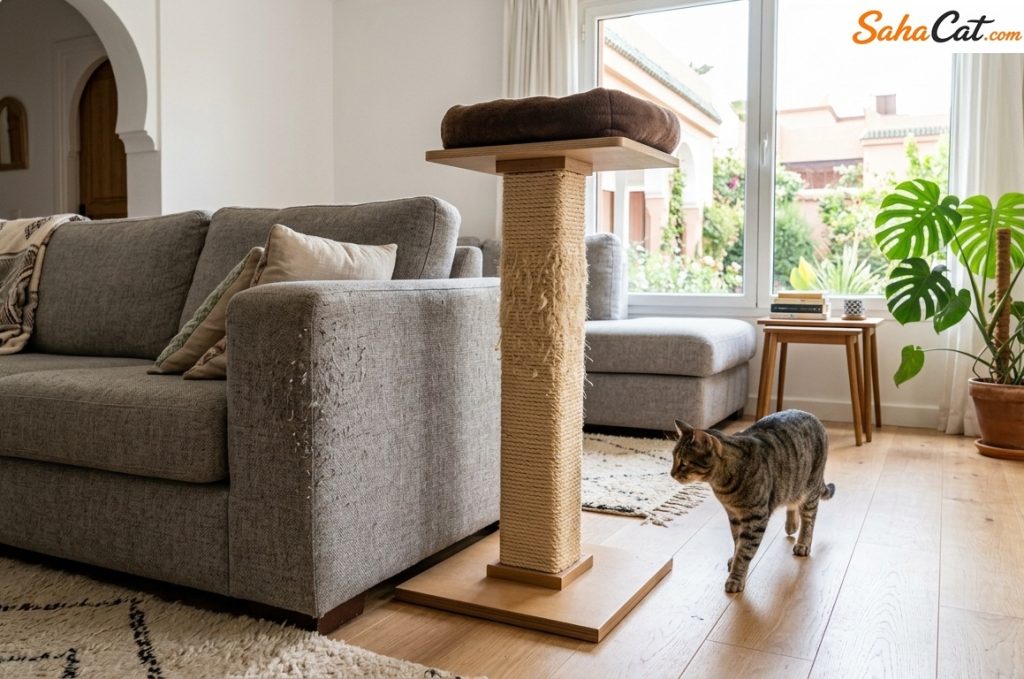
How to Set Up an Apartment for a Cat
You don’t need to buy everything at once. Start with the basic environmental zones your cat needs.
1. A safe retreat
Your cat should have somewhere it can go when it wants peace. This could be:
- A covered cat bed
- A cardboard box
- A cat condo
- A quiet shelf
- A secure elevated perch
Veterinary environmental guidelines emphasize providing cats with safe places where they can retreat, including raised locations that can give them additional security. Don’t treat hiding as bad behavior. Sometimes a cat simply wants to be left alone.
2. A scratching area
Scratching is normal feline behavior. Your apartment should therefore include appropriate scratching surfaces rather than expecting the sofa to serve the purpose. Some cats prefer:
- Vertical posts
- Horizontal cardboard
- Sisal
- Wood
- Other textured materials
Match the surface and orientation to your cat’s actual preferences rather than guessing once and assuming it’s settled.
3. A place to climb
A cat tree is one of the easiest ways to add usable territory without taking over the entire apartment. Choose one that is:
- Stable
- Appropriate for your cat’s size
- Tall enough to be interesting
- Easy to access
- Located where the cat actually spends time
Don’t hide the cat tree in a room nobody uses. Cats often benefit more when elevated furniture is positioned in an active part of the home.
4. Daily play
A cat with plenty of furniture can still become bored. Interactive play gives your cat an opportunity to stalk, chase, pounce, and manipulate objects. Try rotating different toys rather than leaving every toy on the floor permanently. Puzzle feeders can also turn part of mealtime into an activity that requires the cat to work for food.
How to Make a Large House Cat-Friendly
A large house requires a slightly different approach. Instead of concentrating everything in one room, think about creating several useful territories. Your cat might have:
- A sleeping territory — a comfortable, quiet resting area
- A social territory — a place near the family
- An observation territory — a window or elevated perch
- A scratching territory — one or more suitable scratching surfaces
- A play territory — room for toys, chasing, and climbing
- A retreat territory — somewhere your cat can escape activity when necessary
You don’t necessarily need six separate rooms. These can overlap. The point is to give your cat meaningful choices.
Don’t Put Every Resource in One Corner
This is especially important in larger homes and multi-cat households. Cats need access to food, water, toileting areas, scratching areas, resting spaces, and play opportunities. Environmental guidelines recommend separating important resources rather than clustering everything together. For example, you generally don’t want your cat’s food bowl directly beside the litter box. Instead, create sensible separation. In a large home, spreading resources across appropriate areas can also make them easier for your cat to access.
Litter Boxes: Apartment vs. Large House
Litter-box planning can be surprisingly different between the two environments.
In an apartment, the challenge may be finding suitable locations without placing the box somewhere unpleasant or difficult for the cat to access.
In a large house, the temptation is to put all the litter boxes in one convenient room. That isn’t always ideal. A cat shouldn’t have to travel a long distance through the house every time it needs the litter box.
For multi-cat homes, veterinary behavior guidance commonly recommends providing multiple litter boxes, with the general rule of thumb being one box per cat plus one extra. The important thing is not simply counting boxes. Think about access and location.
Exercise: Does a House Give Cats More Exercise?
Not necessarily. A large house gives your cat more potential territory, but cats don’t automatically run laps around it. A cat may spend most of the day sleeping on one sofa regardless of whether the house contains two rooms or ten. Exercise still needs to be encouraged through:
- Interactive play
- Climbing
- Chasing games
- Toys
- Food puzzles
- Exploration
- Opportunities to move between elevated areas
Vertical territory can be particularly useful because climbing and jumping give cats ways to use space actively.
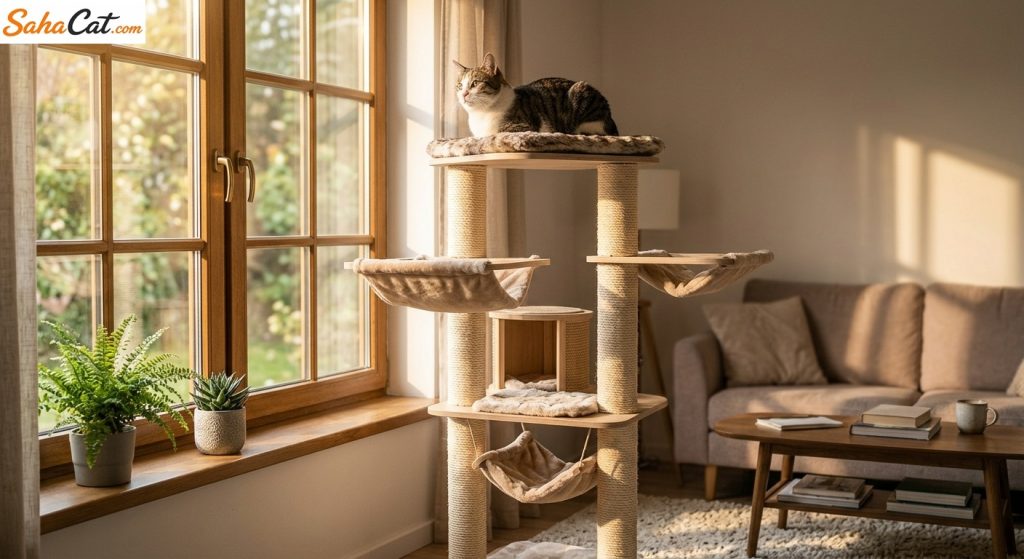
Apartment Cats Need Mental Stimulation, Not Just Physical Space
One of the biggest mistakes apartment owners can make is thinking:
“My cat doesn’t go outside, so I need to give it a bigger apartment.”
Sometimes the better solution is to make the existing space more interesting. Rotate toys. Create observation points. Use food puzzles. Provide hiding places. Change play routines. Introduce safe new objects for investigation. Give your cat opportunities to climb.
Indoor enrichment should accommodate individual preferences because there is no single enrichment setup that works for every cat. This is why observing your own cat is so valuable. One cat may spend hours at a window. Another may prefer a cardboard box. Another may ignore both and obsess over a wand toy. Build around the cat you actually have.
What About High-Energy Cats?
This is where the apartment-versus-house question becomes more complicated. Some individual cats — and some breeds — have substantially higher activity and enrichment needs than others. Breeds including Bengals, Burmese, and Abyssinians are known for higher energy and may benefit from more space and exercise.
That doesn’t mean “you cannot keep an active cat in an apartment.” It means you may need to work harder to provide appropriate enrichment. For a high-energy indoor cat, consider:
- Multiple climbing levels
- Interactive play
- Puzzle feeding
- Multiple scratching areas
- Safe opportunities to run
- Rotating enrichment
- Daily social interaction
A large house may make some of this easier, but it doesn’t eliminate the need to actively engage the cat.
What About Multiple Cats?
The difference between an apartment and a house becomes more noticeable when you have several cats. Cats don’t necessarily want to share everything. One cat may happily eat beside another. Another may prefer privacy. One may want the highest perch. Another may avoid it.
This is why environmental guidelines emphasize providing multiple and separated key resources, particularly in multi-cat homes. A large house gives you more opportunities to separate resources. But an apartment can still work if you deliberately create vertical and spatial separation. For example:
- Cat A: window perch
- Cat B: cat tree
- Cat A: bedroom resting area
- Cat B: living-room hiding area
You’re creating separate options without needing separate houses.
Which Is Better for a Shy Cat?
A large house isn’t automatically better. A shy cat may actually find a huge unfamiliar home overwhelming at first. When moving a cat into a new house, start by initially providing a secure, well-stocked room and gradually allowing access to the wider home as the cat becomes comfortable.
The same principle can work in an apartment. A small, predictable starting area can help a new cat establish a sense of security before gaining access to the rest of the home. For a shy cat, predictability may matter more than square footage.
What About a Cat That Used to Live Outdoors?
This can be one of the more challenging situations. A cat accustomed to spending substantial time outdoors may initially find indoor-only living frustrating. The answer isn’t necessarily to move to a larger house. Instead, recreate some of the activities that made outdoor life stimulating:
- Climbing
- Exploring
- Watching prey
- Searching for food
- Scratching
- Hiding
- Patrolling territory
- Interactive play
Indoor enrichment can help provide outlets for these behaviors. The transition may also need to happen gradually, depending on the cat and its previous lifestyle.
Large House Safety: More Space, More Places to Hide
A large house gives cats more hiding opportunities. That’s good — until the cat chooses somewhere you can’t safely access. Before giving a cat unrestricted access to a new large home, inspect places such as:
- Behind appliances
- Inside unfinished cabinets
- Above suspended ceilings
- Garages
- Utility rooms
- Construction areas
- Open fireplaces
- Small gaps behind furniture
Newly moved cats can hide in areas where they could become trapped, including spaces above ceilings or behind cabinets. Cat-proofing isn’t only an apartment problem.
Apartment Safety: The Smaller the Home, the More Important Windows Become
In an apartment, windows and balconies can represent a disproportionate safety concern because cats may have access to significant heights — this is the same high-rise syndrome risk covered above, and it’s worth repeating here because it’s the single highest-stakes item on this list. Make sure:
- Windows are appropriately secured.
- Screens are strong and properly fitted — a loose or adjustable screen can give way under a cat’s full weight.
- Balcony access is controlled.
- Your cat cannot squeeze through unsafe openings.
- Furniture cannot be used to reach an unsafe window.
Never assume that because a cat has never attempted an escape, it never will. Curiosity can change quickly when a bird, insect, or unfamiliar animal appears outside — and if a fall does happen, get her seen by a vet promptly even if she seems fine, since the ~90% survival rate specifically depends on prompt care rather than a wait-and-see approach.
Does a Large House Mean You Can Leave Your Cat Alone Longer?
No. This is another common misconception. A large home may give a cat more places to explore, but it doesn’t replace social interaction, enrichment, feeding, monitoring, and routine care.
Some cats are relatively independent. Others are strongly people-oriented. Your cat’s individual personality matters. A cat that is comfortable spending several hours resting alone may handle a quiet workday differently from a highly social cat that becomes distressed when left alone.
House size is not a substitute for companionship.
Apartment or House: What Should You Choose?
If you’re deciding where to live specifically because you have a cat, don’t focus exclusively on floor area. Instead, score the home on these questions:
- Can my cat climb? If not, can you safely add vertical space?
- Can my cat hide? Does it have a private retreat?
- Can my cat scratch? Are appropriate scratching surfaces available?
- Can my cat play? Is there enough room for daily interactive play?
- Can my cat observe? Does it have interesting views?
- Can my cat access resources easily? Are food, water, litter, resting, and scratching areas practical?
- Can my cat escape household activity? Is there somewhere children, guests, or other pets cannot constantly disturb it?
- Is the environment safe? Are windows, balconies, appliances, cords, toxic substances, and inaccessible hiding spaces properly managed?
If the answer to most of these questions is yes, the home may be perfectly suitable regardless of whether it’s an apartment or a house.

A Simple Setup for a One-Cat Apartment
You don’t need a mansion. A practical apartment setup might include:
- Living area: stable cat tree, scratching post, interactive play
- Window: secure perch, safe view of outdoors
- Quiet corner: covered bed or hiding box
- Feeding area: food and water positioned appropriately
- Litter area: quiet, accessible location away from food
- Daily routine: interactive play, grooming when appropriate, food puzzles or other enrichment
That can provide a surprisingly rich environment in a relatively small footprint.
A Simple Setup for a Large House
A larger home might use:
- Main living area: cat tree, scratching post, family interaction
- Bedroom: quiet sleeping location
- Window areas: elevated observation spots
- Additional rooms: extra scratching and resting areas
- Multiple-cat homes: distributed litter boxes, separate feeding locations, multiple resting areas, several escape routes
- Throughout the house: safe climbing opportunities, toys and enrichment, cat-proofed hiding spaces
The goal is to make the entire house usable, rather than simply large.
The Biggest Mistake in Both Homes
The biggest mistake isn’t choosing the “wrong” type of home. It’s assuming that the home itself will meet your cat’s needs. An apartment doesn’t automatically provide enrichment. A large house doesn’t automatically provide enrichment either. Your cat needs an environment that lets it behave like a cat. That includes opportunities to:
climb → scratch → hide → rest → explore → play → hunt → observe → interact
The exact arrangement will vary from one cat to another.
Apartment vs. Large House: Final Verdict
If you’re worried that your apartment is too small for a cat, don’t immediately assume you need a bigger home. Start by looking at usable territory. Add vertical space. Create safe hiding places. Provide scratching options. Offer interesting views. Use interactive play. Separate important resources. Build a predictable routine. And observe what your cat actually enjoys.
A large house has genuine advantages, especially for multi-cat households and cats that need more room to move. But unused floor space isn’t the same thing as enrichment. Likewise, a thoughtfully designed apartment can provide a rich and stimulating life for a cat.
The best home for a cat isn’t necessarily the biggest one. It’s the one that gives the cat enough safe, meaningful choices to live naturally.
SahaCat Takeaway
If you live in an apartment: focus on vertical territory, enrichment, window views, scratching areas, smart resource placement — and properly secured screens, given the real fall risk covered above.
If you live in a large house: take advantage of the extra space by distributing resources, creating multiple resting and retreat areas, and making sure the entire environment is safe.
If you have multiple cats: prioritize separate resources and escape options.
If you have a high-energy cat: provide more opportunities for climbing, play, exploration, and food-based enrichment regardless of your home’s size.
And remember: square footage matters — but what your cat can actually do with that space matters more.
Sources consulted: Ellis SLH, Rodan I, Carney HC, et al., “AAFP and ISFM Feline Environmental Needs Guidelines,” Journal of Feline Medicine and Surgery, 2013; VCA Animal Hospitals feline environmental-needs guidance; ASPCA and PetMD (high-rise syndrome); peer-reviewed high-rise syndrome epidemiology data (PMC, 2025).
Last reviewed: 8 September 2026.