
Bringing a new cat home is exciting, but the first few hours can be overwhelming for your new companion. Even a confident cat is entering unfamiliar territory: new smells, sounds, people, rooms, and routines.
The easiest way to make the transition smoother is to prepare before your cat arrives.
Instead of opening the carrier and giving your new cat access to the entire house immediately, create a comfortable starting space where they can eat, sleep, hide, use the litter box, and gradually become familiar with their new surroundings.

Start With a “Home Base”
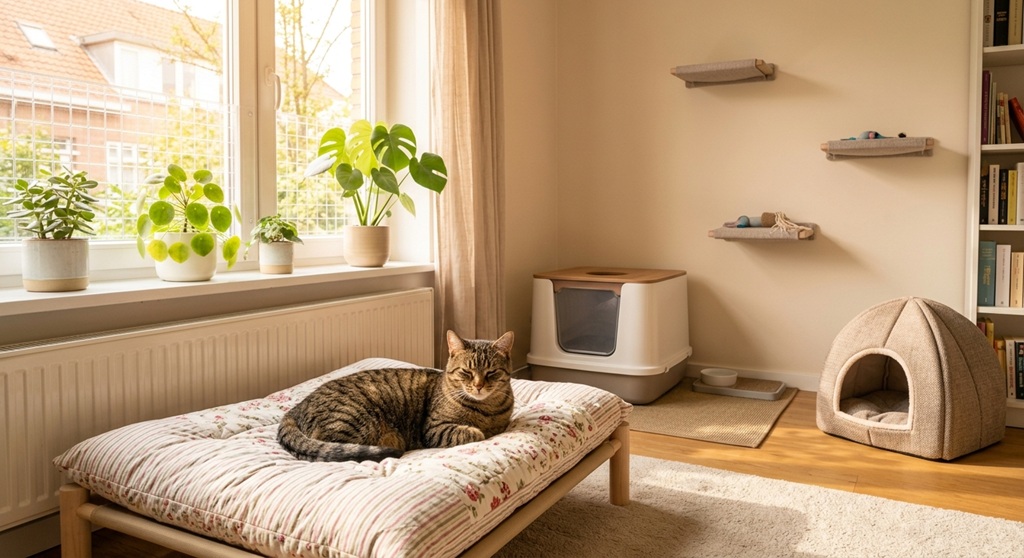
One of the most useful things you can prepare is a dedicated room or quiet area that will serve as your cat’s home base.
This doesn’t need to be an elaborate cat room. A spare bedroom, quiet office, or other secure room can work well. For a young kitten, make sure the room is especially well kitten-proofed.
Inside the room, provide:
- Food and water
- A litter box
- A comfortable resting area
- A hiding place
- A scratching post or pad
- A few appropriate toys
- The cat’s carrier
- A perch or elevated resting option when practical
Keep the area calm and predictable. Your cat should be able to retreat somewhere without being constantly approached.
Don’t hide the carrier away immediately
Leaving the carrier open in the home base can give your cat another familiar place to retreat.
Cat-Proof the Room Before Your Cat Arrives
Getting the room ready isn’t just about comfort. It’s also about preventing accidents — and a couple of these deserve more attention than a quick glance, since they’re genuinely more dangerous than they look.
Cats investigate with their paws, mouths, noses, and bodies. Kittens are especially curious and can squeeze into surprisingly small spaces.
Secure electrical cords
Tie up or cover accessible electrical cords, particularly cords connected to lamps, chargers, computers, or other frequently used equipment.
Remove small objects
Pick up anything that could be swallowed, including:
- Rubber bands
- Small pieces of plastic
- String
- Ribbon
- Loose craft supplies
- Small children’s toys
- Hair ties
- Tiny decorative objects
String, ribbon, and similar objects deserve particular attention because swallowing them can cause serious intestinal problems.
Essential oils and diffusers
Many essential oils are toxic to cats, and this isn’t limited to direct ingestion — diffused oil in the air can be enough to cause a reaction in some cases. If you use a diffuser or potpourri, research whether the specific oil is cat-safe before your cat has access to that room, rather than assuming it’s fine because it’s marketed for home use generally.
Common toxic foods left on counters
Onions, garlic, chocolate, and grapes or raisins are all dangerous to cats, even in small amounts. A curious new cat exploring counters for the first time is exactly the situation these hazards catch people off guard in — worth a deliberate check of what’s left out, not just an assumption that a cat won’t bother with human food.
Appliance safety
This is easy to overlook, and it shouldn’t be — cats climbing into washers and dryers is a well-documented cause of serious injury and death, not a rare fluke. Cats are drawn to the warm, enclosed, dark space, and they’re quiet enough that it’s genuinely possible not to notice one has climbed in. Keep washer and dryer doors closed when not in use, and get in the habit of checking inside — a quick visual check or a sweep of the hand — before starting any cycle, every time.
Reclining chairs and sofa beds
The internal mechanisms in reclining chairs and sofa beds have caused serious injury to cats who crawl inside or underneath while the mechanism is in use. Check underneath before reclining if your new cat has access to the room, especially in the first weeks while you’re still learning her hiding habits.

Check hiding spaces
Look behind furniture, inside cabinets, under beds, and around appliances.
You don’t need to eliminate every hiding place. Cats benefit from having safe places to retreat.
The goal is to block dangerous or inaccessible spaces where your cat could become trapped.
Secure windows and doors
Make sure windows have secure screens and that doors close properly. This is worth taking seriously rather than treating as a formality: veterinarians call the injuries from a fall out an open window or off a balcony high-rise syndrome, and it’s common enough in cat households to deserve real attention. A loose or adjustable screen can give way under a cat’s weight, so check that screens are snug and properly secured, and keep windows only cracked rather than fully open when you’re not there to supervise. Be especially careful when people are entering and leaving the house during the first few days, since an unfamiliar cat is more likely to bolt through a door left open even briefly.
Check Your Houseplants — Specifically, Check for True Lilies
Don’t assume a plant is safe simply because cats have never shown interest in it. Some plants can be poisonous to cats, and one category deserves far more attention than “some plants can be poisonous” usually gets: true lilies and day lilies (Lilium and Hemerocallis species — including Easter, Tiger, Stargazer, and Oriental varieties) cause fatal acute kidney failure in cats, and it takes very little exposure to do it. Eating a petal or leaf, licking pollen off her fur, or even drinking water from a vase that held the flowers can be enough. Symptoms can begin within a couple of hours, and kidney failure can develop within 24 to 72 hours. Treatment started within about 18 hours of exposure has a good chance of success; delayed much beyond that, the damage is frequently irreversible and fatal. There’s no antidote — the only real prevention is not bringing these lilies into a home with a cat at all.
One clarifying point worth knowing so you don’t panic unnecessarily: peace lilies and calla lilies are a completely different, much less dangerous category — they can cause mouth and stomach irritation from oxalate crystals, unpleasant but not the kidney-failure risk true lilies pose. If you’re ever unsure which type of lily you’re dealing with, treat it as the dangerous kind and call your vet or a poison control line immediately.
Before bringing your new cat home, identify the plants in your house and check whether they’re toxic to cats. Remove potentially dangerous plants from areas the cat can access.
Set Up the Litter Box Before Arrival
Your cat shouldn’t have to search the house for the bathroom.
Put the litter box in an accessible, relatively quiet location before your cat arrives. Don’t put it directly beside the food and water.
Choose the litter carefully
If you know what litter your cat has already been using, starting with the same type can make the transition easier.
Avoid making several major changes at once. Your goal during the first few days is familiarity, not experimentation.
Think about location, not just the box
Choose somewhere:
- Easy for your cat to reach
- Relatively quiet
- Not constantly crowded
- Away from food
- Free from anything that could trap the cat
If you have multiple cats, resource planning becomes even more important.
Prepare Food and Water Stations
Have your cat’s food and water ready before they arrive.
If possible, find out what food the cat has been eating and begin with that rather than immediately changing everything.
Place food and water away from the litter box and avoid putting bowls directly in the busiest part of the house.
Give Your Cat Somewhere to Hide
A hiding place isn’t a sign that your cat is unhappy with you.
For a new cat, hiding can simply be a way to feel secure while processing an unfamiliar environment.
A hiding option can be as simple as:
- An open carrier
- A cardboard box
- A covered cat bed
- A quiet space under appropriate furniture
The important distinction is between safe hiding and inaccessible hiding.
Add a Scratching Option Before the Cat Arrives
Don’t wait until your cat scratches the sofa before buying a scratching post.
Put at least one appropriate scratching surface in the home base from the beginning.
A sturdy vertical post is useful for cats who like to stretch upward, while some cats prefer horizontal scratching pads.
Placement matters too. If your cat later starts scratching a particular piece of furniture, putting an appropriate scratching surface nearby can be more effective than simply placing a scratching post somewhere else.

Create Opportunities to Climb and Observe
Cats don’t experience a home only at floor level.
A perch, sturdy cat tree, shelf, or other safe elevated location can give your cat a place to observe what’s happening around them while also providing useful vertical space.
This can be especially valuable in smaller homes.
If you use a tall cat tree or climbing structure, make sure it is stable and cannot easily tip over.
Prepare a Few Toys — Not a Whole Toy Store
It’s tempting to buy everything when you’re preparing for a new cat.
You don’t need to.
Start with a small selection:
- A lightweight toy for chasing
- A toy for interactive play
- A simple ball or other movable toy
- Something appropriate for independent exploration
Watch what your cat actually enjoys.
For toys involving strings, ribbons, or similar materials, supervise play and put them away afterward rather than leaving potentially swallowable material accessible.
Think About Your Cat’s First Night
The first night doesn’t need to be an adventure.
Keep the home base prepared with:
- Fresh water
- Food
- A clean litter box
- A comfortable sleeping area
- A hiding place
- The open carrier
- A few safe toys
Keep noise and activity under control.
Don’t be surprised if your cat hides for a while. Some cats begin exploring almost immediately. Others need much longer.
There is no universal timetable.
If You Have Children, Prepare Them Too
Preparing the home isn’t only about furniture and supplies. The people in the home need preparation as well.
Children should understand that a new cat isn’t a toy.
Establish a few simple rules before the cat arrives:
- Let the cat approach rather than chasing them.
- Don’t pull the cat out of a hiding place.
- Don’t disturb the cat while eating or using the litter box.
- Don’t pick up the cat without appropriate supervision.
- Give the cat space when they move away.
- Use gentle hands and calm voices.
Young children should be supervised around a new cat, especially during the adjustment period.

If You Already Have a Cat, Don’t Introduce Them Immediately
If you’re adding a cat to a cat household, prepare a separate space for the newcomer.
The new cat should have their own:
- Food
- Water
- Litter box
- Sleeping area
- Scratching surface
- Toys
- Hiding places
Gradual introductions can begin with separation and scent exchange before face-to-face meetings.
The same principle applies when introducing a new cat to a dog: give everyone a safe space and don’t rush the process.
Make a Plan for Other Pets
Before the new cat arrives, ask yourself:
Where will each animal be during the first few hours?
You may need:
- A closed room for the new cat
- A separate area for your existing pet
- Baby gates or other barriers where appropriate
- Separate food and water stations
- A plan for gradual introductions
Having this decided beforehand prevents you from trying to improvise while holding a nervous cat in a carrier.
Don’t Give Your New Cat the Entire House Immediately
A large house can actually be more overwhelming than a small apartment during the first few days.
Starting with a single prepared room can be useful.
Once your cat is eating, using the litter box, exploring, and showing signs of comfort, you can gradually introduce additional areas.
There isn’t a fixed number of days every cat must spend in one room. The cat’s behavior should guide the pace.
Walk Through Your Home Like a Cat
Before bringing the cat home, do one final inspection.
Get down low and look around.
Ask yourself:
Could a kitten fit through that gap?
Could something fall over if the cat climbs on it?
Can the cat reach that cord?
Is there a true lily, or another toxic plant, within reach?
Could a door accidentally trap the cat?
Is there somewhere the cat could disappear and become inaccessible — including inside a washer or dryer?
Can the cat reach an open window or an unsecured balcony?
Are cleaning products, medications, and chemicals securely stored?
This final inspection often catches problems that are easy to overlook when you’re looking at the room from a human perspective.
The New-Cat Shopping List
You don’t need every cat product on the market.
Start with the essentials.
Must-have items
- Cat carrier
- Appropriate cat food
- Food bowl
- Water bowl
- Litter box
- Appropriate litter
- Litter scoop
- Scratching post or pad
- Comfortable bed or blanket
- Safe hiding place
- A few toys

Useful additions
- Cat tree or elevated perch
- Grooming brush
- Nail trimmers
- Interactive toys
- Food puzzle or enrichment toy
- Storage container for cat food
- Enzymatic cleaner for accidents
- Identification tag where appropriate
For the reasoning behind choosing between options in each category, see our full supplies buying guide.
What to Prepare on the Day Before
The day before your cat arrives, try to have the important decisions already made.
Your final checklist
Home safety
- Electrical cords secured
- Dangerous small objects removed
- True lilies and other toxic plants removed or made inaccessible
- Windows and doors secured
- Dangerous gaps blocked
- Cleaning products and medications secured
- Unsafe hiding spaces blocked
- Washer and dryer doors kept closed, checked before every use
- Essential oil diffusers checked for cat safety or removed
Home base
- Quiet room selected
- Carrier placed inside
- Hiding place available
- Comfortable resting area prepared
- Scratching surface installed
- Safe toys available
Food and water
- Food purchased
- Food and water bowls ready
- Feeding location chosen
Litter
- Litter box ready
- Familiar litter available if known
- Litter scoop ready
- Box positioned away from food
Household
- Children know the basic rules
- Existing pets have separate spaces
- Introduction plan prepared
- Everyone knows which room the new cat will start in
What Not to Do When Your Cat Arrives
Some of the most common mistakes come from good intentions.
Don’t force the cat to explore
Opening every door and carrying the cat around the house may feel welcoming to you, but it can be overwhelming for the cat.
Let them investigate at their own pace.
Don’t pull the cat out of hiding
If the hiding place is safe, give your cat time.
You can sit quietly nearby and allow the cat to decide when to interact.
Don’t change everything at once
A new home is already a major change.
If possible, keep familiar food, litter, bedding, and routines during the initial adjustment period.
Don’t immediately introduce every family member and pet
Your new cat doesn’t need a house tour, a family photo session, and a meeting with three other animals on the first hour home.
Start small.
The Goal Isn’t a Perfect Cat Room
You don’t need to transform your home into a professional cattery before adopting a cat.
What your cat needs most is a safe starting point, predictable resources, opportunities to hide and rest, appropriate places to scratch and play, and time to adjust.
The best preparation is less about buying more products and more about thinking through how your cat will actually use the space.
A cardboard box may become more valuable than an expensive bed.
A strategically placed scratching post may be more useful than a room full of toys.
A quiet corner may matter more than an elaborate cat tree.
And a calm first week may be more important than giving your cat immediate access to every room.

Final Takeaway
Preparing your home before bringing a new cat is really about creating choices.
Your cat should have somewhere safe to retreat, somewhere appropriate to scratch, a clean place to use the litter box, separate food and water areas, opportunities to play and climb, and enough time to become comfortable. And two specific risks — a true lily in a bouquet, or an unattended washer or dryer — deserve a deliberate check precisely because they don’t look dangerous at a glance.
Start with one well-prepared space. Make the rest of the home safe. Keep the first few days calm. Then allow your cat’s behavior to determine when it’s time to explore more.
You don’t need to make your home perfect before your new cat arrives.
You just need to make it safe, comfortable, and ready for them to make it their own.
Sources: ASPCA (lily toxicity, poison control guidance); PetMD; FDA Center for Veterinary Medicine; MSPCA-Angell; Animal Medical Center of New York (appliance safety).
Last reviewed: 14 September 2026.