
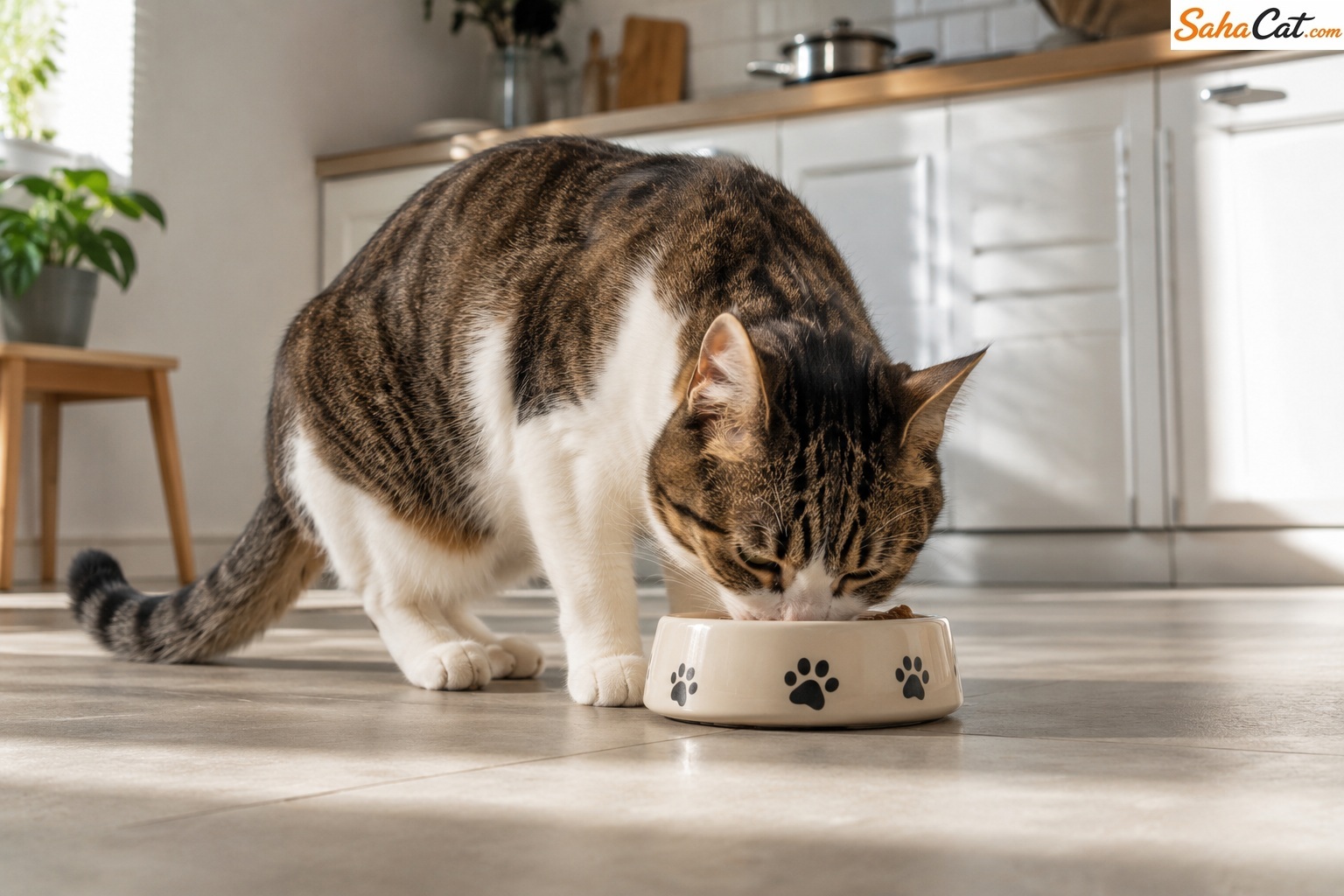
For many healthy adult cats, two meals a day is a sensible starting point. But that doesn’t mean every cat should eat exactly twice a day.
Kittens have different nutritional demands from adults. Some cats do better with three or four smaller meals, while others naturally prefer eating small amounts throughout the day. A cat’s weight, activity level, health, food type, and ability to regulate its own intake can all change the best feeding routine.
The most important thing is to separate two questions that are often confused: how often should my cat eat? and how much food should my cat receive each day? Meal frequency determines how you divide the food. It does not, by itself, determine how many calories your cat needs.
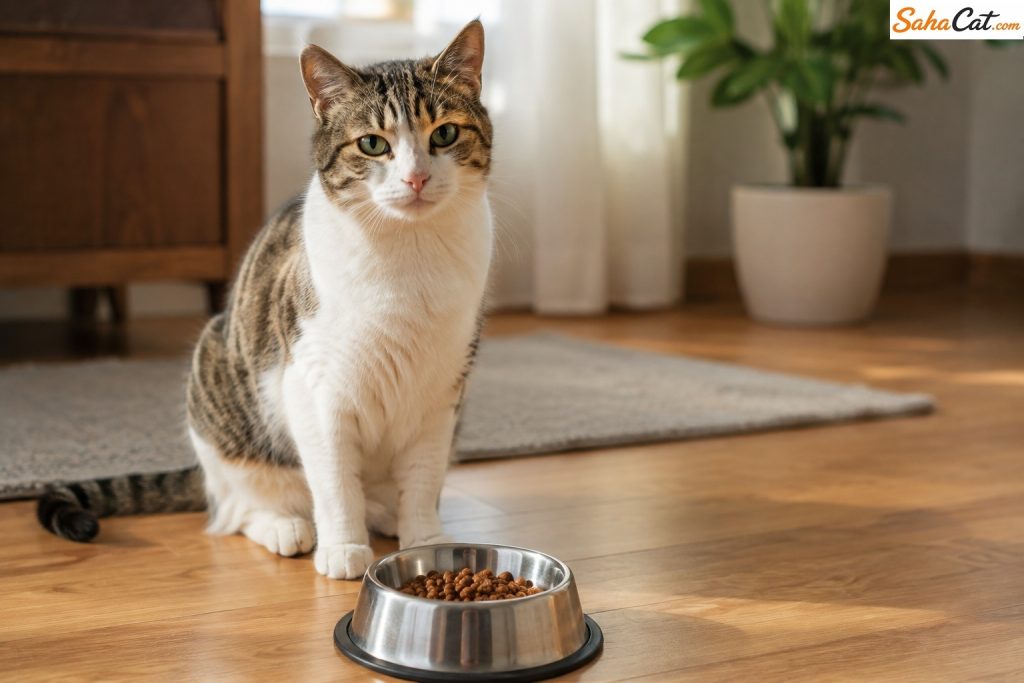
The Short Answer
For most healthy cats:
| Cat’s life stage | A practical starting point |
|---|---|
| Very young kittens | Several small feedings; frequency depends heavily on age and whether they are nursing or weaned |
| Kittens up to about 6 months | Around 3 meals per day |
| Kittens 6–12 months | Usually 2 meals per day |
| Healthy adult cats | Usually 2 meals per day; some do well with 3–4 smaller meals |
| Senior cats | Often the same schedule as adults unless their veterinarian recommends otherwise |
| Pregnant or nursing cats | Higher energy needs; feeding plans may need to be adjusted substantially |
Cornell’s feline health guidance recommends three meals a day for kittens up to six months, twice daily from six months to one year, and once or twice daily for most adults. VCA’s veterinary nutrition guidance notes that at least two meals per day is a common recommendation for adult cats, while some cats benefit from more frequent smaller meals. These are starting points — not rules that every cat must follow.
Why Feeding Frequency Changes With Age
A kitten is not simply a smaller adult cat. Growing kittens need considerably more energy relative to their body size, and their small stomachs make it difficult to consume everything they need in one or two large meals. Veterinary guidance therefore generally favors several smaller meals during early growth. As a kitten grows, its feeding routine can gradually become less frequent.
Kittens younger than 6 months
A practical target for a weaned kitten is about three meals a day. The food should be formulated for growth rather than simply being adult maintenance food. VCA notes that kittens have higher energy requirements and should receive food appropriate for their growth stage. Very young kittens that have not been weaned are different — orphaned newborns may require feeding every few hours, depending on their age and circumstances. That’s a specialized situation rather than a normal feeding schedule for a weaned household kitten.
Kittens 6–12 months
By six months, many kittens can move toward two meals per day, although individual needs vary. VCA recommends continuing a growth-formulated diet until the kitten is finished growing, typically around 12 months, while Cornell describes twice-daily feeding as generally appropriate between six months and one year.
Adult cats
Once a cat reaches adulthood, two meals a day is a useful default for many cats — morning and evening, each a measured portion. This creates a predictable routine while making it easier to monitor how much your cat actually eats. Some cats may do better with three or four smaller meals, particularly if they become very hungry between meals or prefer smaller amounts at a time.
Senior cats
Getting older does not automatically mean your cat needs a completely different feeding schedule. Cornell notes that cats aged 10 and older can generally maintain the same feeding regimen unless a veterinarian recommends otherwise. What may change is the diet, calorie requirement, appetite, or medical needs. A senior cat that begins eating much more, eating much less, losing weight, or changing its usual eating pattern should not simply be put on a new schedule without considering why the change occurred.
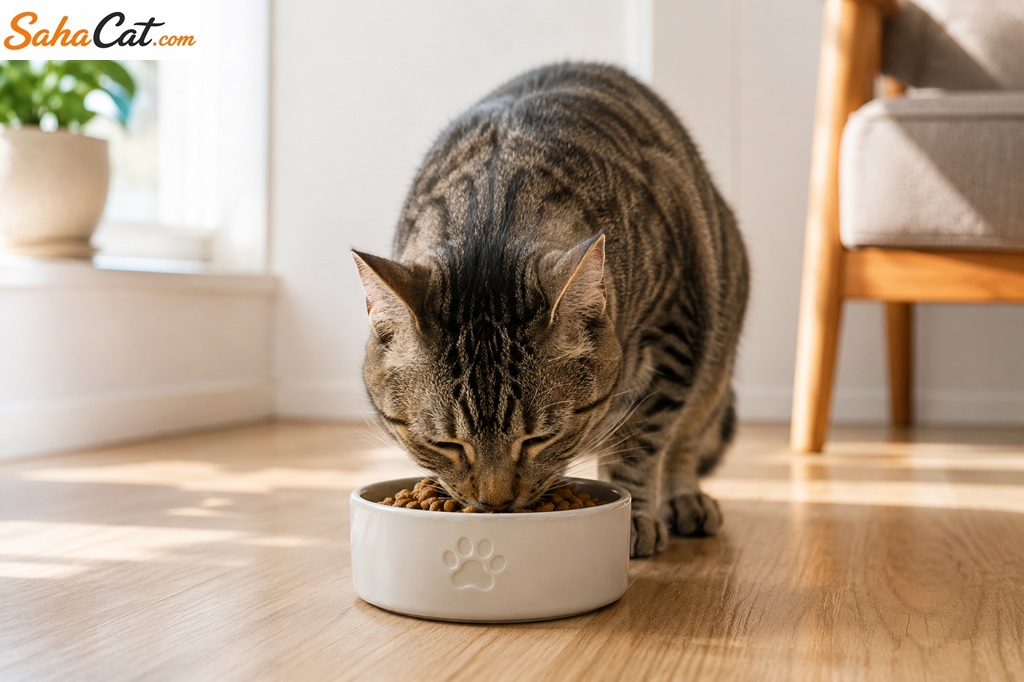
Is Feeding a Cat Twice a Day Enough?
For many healthy adult cats, yes. Two scheduled meals can work particularly well because they create a predictable routine and make it easier for you to monitor food intake. But “twice a day” does not mean every cat must go approximately 12 hours without any food. Some cats naturally prefer smaller meals spread throughout the day — VCA notes that cats left to their own devices may eat many small meals, sometimes 12–20 times in a day. That doesn’t mean you need to serve 20 separate meals. Instead, you can divide the cat’s total daily food allowance into several smaller portions — for example, one daily allowance divided into 3 or 4 smaller meals. The total amount remains controlled while the feeding pattern better matches the cat’s preference.
Should You Feed Your Cat Three or Four Times a Day?
You can, if it fits your cat’s needs and your schedule. More frequent meals may be useful for cats that beg repeatedly between meals, eat only small amounts at once, do better with smaller portions, have difficulty managing a large meal, or prefer frequent feeding opportunities. VCA specifically notes that three or four meals can help some cats that beg between meals or only eat a small amount at one sitting. There’s no prize for choosing the fewest meals possible — the better schedule is the one that provides appropriate nutrition, keeps portions controlled, and works consistently for both you and your cat.
What Matters More Than the Number of Meals?
The total daily amount of food. Imagine your cat should receive a particular daily calorie allowance. If you divide that food into two meals, you might offer approximately half at breakfast and half at dinner. If you divide it into four meals, each meal would be smaller — the frequency changes, but the daily food allowance does not automatically change. This matters because increasing the number of meals can accidentally increase the total amount fed. A cat receiving four meals is not automatically supposed to receive four times the food.
How Much Should You Feed at Each Meal?
There isn’t one portion size that’s correct for every cat. Your cat’s calorie needs depend on body size, age, activity, neutering status, body condition, health, and the calorie density of the food itself. Pet-food labels provide feeding guidance, but those recommendations are based on general needs rather than a perfect calculation for every individual cat. Cornell notes that cats vary considerably in how much food they require and recommends working with a veterinarian to determine an appropriate body weight and feeding plan. If your cat is gaining weight despite following the label, the solution may not be to feed less frequently — the total daily calories may need adjustment. Likewise, a highly active or underweight cat may need a different plan.
A Simple Way to Divide Your Cat’s Daily Food
Suppose you’ve already determined the appropriate daily amount of food for your cat. You can divide that amount according to your chosen schedule:
- Two meals: 50% morning + 50% evening
- Three meals: ⅓ morning + ⅓ afternoon + ⅓ evening
- Four meals: ¼ morning + ¼ midday + ¼ afternoon + ¼ evening
These percentages are simply ways to divide a known daily amount — they are not calorie recommendations. If your cat’s daily food allowance is uncertain, establish that first rather than choosing a portion based only on meal frequency.

Is Free-Feeding a Cat a Good Idea?
Sometimes — but not for every cat. Free-feeding means making food available so the cat can eat whenever it wants. Some cats can regulate their intake reasonably well, particularly when dry food is measured carefully. But free-feeding makes it harder to know exactly how much a cat has eaten, and some cats will simply consume more calories than they need, which can contribute to overweight and obesity.
Free-feeding may be less suitable if your cat gains weight easily, eats everything immediately, begs despite having food available, has difficulty regulating its intake, lives with other cats that share the same food, or needs precise calorie control. For these cats, measured meals can make food intake much easier to manage.
What If Your Cat Likes to Graze?
You don’t necessarily have to eliminate grazing overnight. Instead, measure the entire day’s food in advance. Rather than continually refilling the bowl, place the day’s measured allowance in it and monitor what remains. VCA describes this approach for cats that prefer grazing: measure the daily portion and track what’s left so you can determine how much the cat actually consumed. This is much better than repeatedly topping up a bowl without knowing how much your cat has eaten. If you later want to transition your cat to scheduled meals, you can divide that same daily amount into several feeding times and gradually establish a routine.
Wet Food Changes the Equation
Wet food can be included in a feeding schedule just like dry food, but it behaves differently once served. Moist food shouldn’t simply be left sitting out indefinitely because it can spoil — VCA notes that wet food is better suited to meal feeding than unrestricted free access for this reason, which makes scheduled feeding particularly practical for cats eating primarily wet food. If you feed a combination of wet and dry food, remember to account for both foods in the daily total — adding wet food on top of the full daily dry-food allowance can unintentionally increase calorie intake.
Should Cats Have Food Available Overnight?
Not necessarily. A healthy adult cat doesn’t automatically need a bowl filled with food overnight just because cats are naturally inclined to eat small meals. If your cat does well with two or three scheduled meals, there may be no reason to leave an unlimited amount of food available while everyone sleeps. However, some cats genuinely prefer small, frequent meals — for these cats, a measured late-evening meal or an appropriately programmed automatic feeder can be a practical solution. The important distinction is between frequent controlled feeding and unlimited food availability. They are not the same thing.
What If Your Cat Wakes You Up for Food?
If your cat has learned that waking you at 5 a.m. produces breakfast, the behavior can become part of the routine. Before changing the schedule, look at the bigger picture: is your cat receiving enough food overall? Is its weight appropriate? When is the last meal? Does it eat most of its food immediately? Has the early-morning hunger suddenly appeared? If the cat is healthy and simply anticipates breakfast, moving some of the day’s measured food to a later evening meal — or using an automatic feeder — may help reduce the association between waking you and receiving food. But a new, unusually intense appetite shouldn’t automatically be treated as a behavioral issue. If it occurs alongside weight loss or other changes, speak with your veterinarian.
What If Your Cat Doesn’t Finish a Meal — or Stops Eating Altogether?
Don’t immediately assume that your cat is simply being picky. One unfinished meal can happen for many harmless reasons. But cats are creatures of habit, and a persistent change in appetite can be important. VCA notes that regular feeding makes changes in eating behavior easier to detect — if food is repeatedly left behind when a cat normally finishes its meals, that can be a useful warning sign. Pay particular attention if reduced eating is accompanied by weight loss, vomiting, diarrhea, lethargy, hiding, changes in drinking, or other unusual behavior.
Here’s the part worth being specific about rather than just saying “see a vet”: cats are unusually vulnerable to a condition called hepatic lipidosis (fatty liver disease) when they go too long without eating. When a cat stops eating, her body mobilizes fat stores for energy, but a cat’s liver has limited capacity to process that fat quickly — the excess can accumulate inside liver cells faster than in most other species, and this can begin developing in as little as 24 to 72 hours of reduced or absent food intake. It’s genuinely life-threatening without treatment. Overweight cats are at meaningfully higher risk, since more stored fat means more fat available to overwhelm the liver at once — which means the cat most likely to have a meal “skipped on purpose,” out of a well-meaning effort to manage her weight, is often exactly the cat this condition is most dangerous for.
As a general guideline: a healthy adult cat who hasn’t eaten at all in 48 hours needs a vet call, and an overweight cat, a kitten, or a cat with a known illness needs one sooner — within 24 hours of eating nothing. This isn’t a reason to force-feed a cat at home; it’s a reason to involve your vet promptly rather than waiting to see if she “comes around” on her own. A cat that refuses food and is losing weight should be evaluated by a veterinarian — Cornell specifically warns that cats that stop eating can develop serious health problems, and hepatic lipidosis is the specific reason why that warning matters more for cats than it typically would for a dog in the same situation.
What About a Cat That Always Seems Hungry?
A cat asking for food does not necessarily mean it needs more food. Some cats learn that begging gets results. Others may be receiving meals that are too small for their individual needs. And some cats may have an underlying medical issue. Start by checking the basics:
- Check the daily amount: are you actually measuring the food?
- Check body condition: does your cat maintain a healthy body condition, or is weight increasing?
- Check the food: different foods can contain very different amounts of calories per gram, cup, or can.
- Check for a change: has the appetite become noticeably stronger than it used to be? If your cat has a persistent increase in appetite, especially together with weight loss or increased thirst/urination, consult your veterinarian rather than simply increasing the food.
Do Cats Need to Eat at Exactly the Same Time Every Day?
A consistent routine is useful, but you don’t need to treat feeding time like a laboratory experiment. Feeding around similar times each day helps cats predict when food is coming and can make daily care easier. VCA recommends establishing a regular feeding schedule and maintaining it consistently — for example, breakfast at 7:00 a.m., lunch at 1:00 p.m. if needed, and dinner at 7:00 p.m. The exact times can be adjusted around your household. A schedule you can maintain consistently is usually more useful than an “ideal” schedule you cannot realistically follow.
Feeding Multiple Cats in the Same Home
A shared food bowl can make feeding surprisingly difficult. One cat may eat quickly while another eats slowly. One may need more calories, another fewer. A confident cat may prevent a quieter cat from getting its intended portion. Cornell notes that in multi-cat households, feeding cats separately or in different parts of the home can sometimes help when competition or overeating becomes a problem. If you have several cats, consider individual bowls, separate feeding locations, measured portions, monitoring who eats what, and feeding cats behind closed doors when necessary. This becomes especially important when one cat is on a therapeutic or weight-management diet.
What About Pregnant or Nursing Cats?
Pregnancy and nursing are different from ordinary adult maintenance. A nursing mother may have dramatically increased energy requirements, particularly as milk production rises. VCA recommends providing highly energy-dense food and allowing small meals or appropriate free-choice access during this demanding period, while carefully monitoring intake. This is one situation where a standard “feed twice a day” rule may be completely inappropriate. If your cat is pregnant or nursing, ask your veterinarian for a feeding plan based on her stage of pregnancy/lactation, body condition, litter size, and diet.
Cats With Medical Conditions May Need a Different Schedule
Meal frequency can become part of medical management. Some cats with diabetes may require carefully coordinated feeding and medication schedules. Other conditions can affect appetite, digestion, calorie requirements, or the type of food that should be offered. Cornell notes that cats with certain diseases may require modified diets and veterinary-directed feeding plans. If your cat has been diagnosed with a medical condition, don’t change its feeding schedule based solely on general internet advice — follow the plan provided by your veterinary team.
A Practical Feeding Schedule for a Typical Adult Cat
For a healthy adult cat that maintains an appropriate weight, a simple routine might look like this:
- Option 1 — Two meals: 7:00 a.m. (half of daily food), 7:00 p.m. (half of daily food). A straightforward choice for many households.
- Option 2 — Three meals: 7:00 a.m., 2:00 p.m., 9:00 p.m., each ⅓ of the daily total. May work well for cats that prefer smaller meals.
- Option 3 — Four smaller meals: 7:00 a.m., 12:00 p.m., 5:00 p.m., 10:00 p.m., each approximately one-quarter of the day’s measured food.
Again, these schedules illustrate how to divide food, not how many calories your cat should receive.
How to Know Whether Your Feeding Schedule Is Working
Don’t judge the schedule only by whether your cat appears excited about food. Look at the cat. A useful feeding routine should help you maintain a healthy body condition, stable and appropriate weight, normal appetite, predictable eating habits, appropriate energy and activity, and a consistent daily routine. Regularly monitoring your cat’s body condition is more useful than relying only on the number printed on a food package. Cornell emphasizes that cats vary in their individual food requirements and that maintaining an appropriate body weight is an important part of feline health.
Common Feeding Mistakes
- Feeding by bowl size instead of measurement — a large bowl makes it easy to lose track of how much food your cat is receiving.
- Increasing food every time your cat begs — begging is not a reliable measurement of calorie requirements.
- Changing the number of meals without changing portions — four meals can easily become four full portions if you’re not careful.
- Free-feeding a cat that overeats — unlimited access is convenient, but it isn’t appropriate for every cat.
- Ignoring weight changes — a feeding schedule that worked six months ago may no longer be appropriate if your cat’s weight, activity, or health has changed.
- Treating kittens like miniature adults — growing kittens need food formulated for growth and generally require more frequent feeding than mature cats.
So, How Often Should You Feed Your Cat?
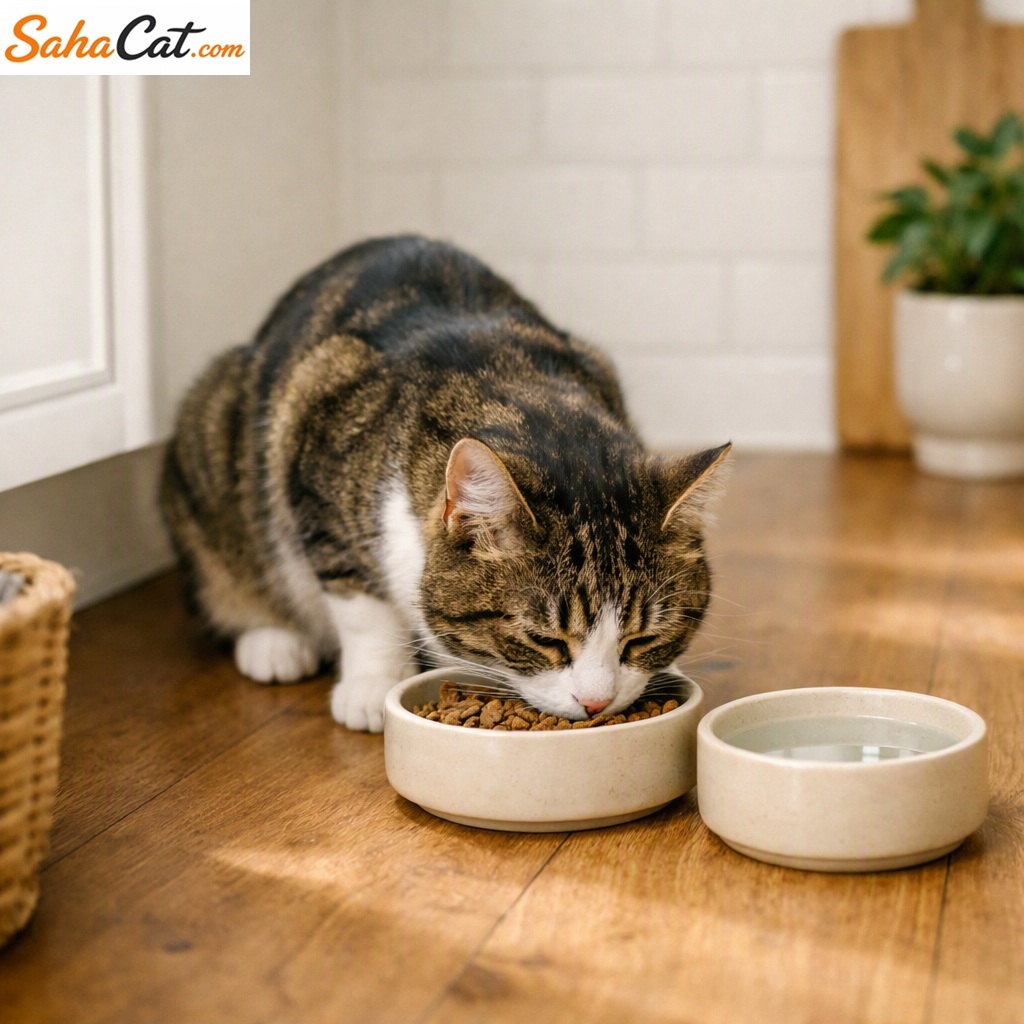
For a healthy adult cat, start with two measured meals per day and adjust if your cat’s individual needs suggest that smaller, more frequent meals would work better. For kittens, meals are generally more frequent while they’re growing — often around three meals per day through the first six months, then moving toward twice-daily feeding as they mature. For senior cats, the same basic schedule can often continue unless health or nutritional needs require a change. And for cats that are pregnant, nursing, overweight, underweight, or dealing with a medical condition, a personalized feeding plan may be more appropriate.
The biggest mistake is focusing only on the clock. The best feeding routine combines the right food, the right total daily amount, an appropriate number of meals, and regular monitoring of your cat’s body condition — and, just as importantly, recognizing when a cat isn’t eating at all is a same-day concern, not a scheduling question.
SahaCat Feeding Rule of Thumb
- Healthy adult cat → 2 meals/day
- Young kitten → 3 smaller meals/day
- Cat that prefers small meals → consider 3–4 measured meals/day
- Overweight or food-obsessed cat → prioritize measured portions and calorie control
- Pregnant, nursing, or medically managed cat → ask your veterinarian for an individualized plan
- Any cat that has eaten nothing for 24–48 hours → call your vet — don’t wait it out
And remember: feeding more frequently does not automatically mean feeding more food. It simply means dividing the appropriate daily amount into smaller portions.
Sources consulted: Cornell University College of Veterinary Medicine and VCA Animal Hospitals veterinary nutrition resources; PetMD, University of Illinois College of Veterinary Medicine, and MSD Veterinary Manual (hepatic lipidosis).
Last reviewed: 10 September 2026.