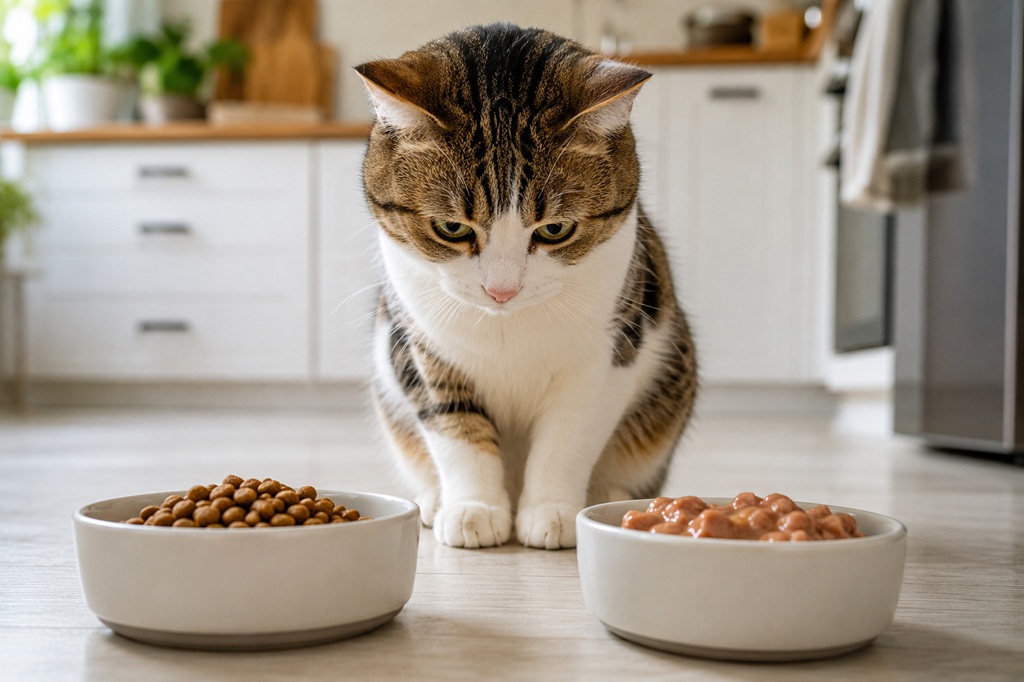
Most comparisons of dry and wet cat food default to a pros-and-cons list, which tends to bury the two facts that actually matter most: one common belief about dry food is contradicted by veterinary dental guidelines, and the format itself matters less than whether a specific food is properly formulated and complete — a distinction that studies show isn’t guaranteed by either category.

First, the Myth Worth Retiring: Dry Food Doesn’t Clean Teeth
This is one of the most persistent claims in cat nutrition, and it’s not well supported. The World Small Animal Veterinary Association’s Global Dental Guidelines state that standard dry foods don’t meaningfully reduce the risk of periodontal disease. The mechanical logic sounds reasonable — crunching should scrape plaque — but most cats bite kibble into fragments rather than chewing it, and standard kibble tends to shatter before it can scrape anything near the gumline, which is where periodontal disease actually starts. Specially formulated dental diets, evaluated and accepted by the Veterinary Oral Health Council, are a genuinely different product — larger, more fracture-resistant kibble engineered to contact the tooth longer — and they’re not the same thing as a regular bag of dry food. If dental health is the reason you’re choosing dry food, it’s the wrong reason; daily brushing and professional cleanings do far more than food format ever will.
Hydration: The Difference That’s Actually Measurable
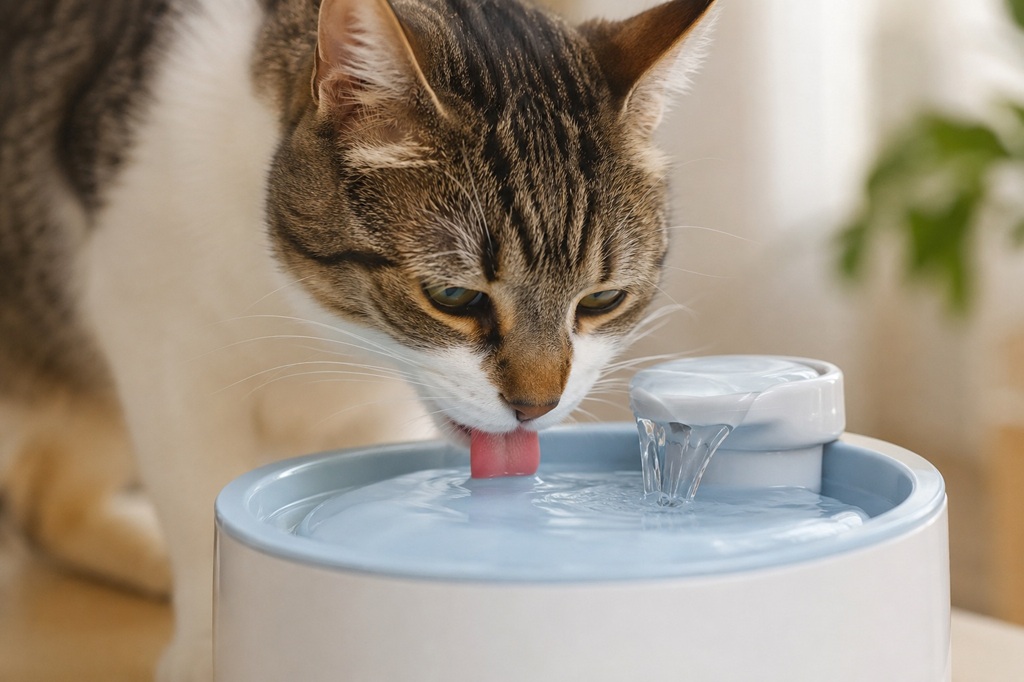
Wet food runs around 70–80% moisture; dry food is typically closer to 5–10%. That gap matters more for cats than it would for many other species, because cats evolved as desert-adapted hunters whose natural prey-based diet supplied most of their water — they don’t reliably compensate for a low-moisture diet by drinking more on their own. A controlled study (Buckley et al., 2011, British Journal of Nutrition) found that cats eating wet food had significantly higher total water intake than cats eating dry food, even when the dry-fed cats drank more from their water bowl than the wet-fed cats did — the extra drinking didn’t fully make up the difference.
This connects directly to urinary health. A 2024 study in PLOS ONE found that both higher food moisture and a lower starch-to-protein ratio reduced urine supersaturation for the crystal types behind the most common bladder stones in cats. Wet food’s moisture advantage isn’t a marketing point — it’s a mechanism with a documented effect on exactly the urinary risks discussed in more detail in our UTI and lower urinary tract article.
Carbohydrate Load: A Structural Difference, Not Just a Recipe Choice
Cats are obligate carnivores — their natural prey-based diet is estimated at only about 1–2% carbohydrate on a dry matter basis. Dry kibble, by contrast, generally requires a meaningfully higher starch content than wet food to hold its shape during manufacturing, which means the format itself pushes carbohydrate levels up, not just the specific recipe. This is most relevant for cats managing diabetes or prediabetes, where vets often recommend a lower-carbohydrate diet — frequently steering toward wet food specifically because of this structural difference, not brand preference.
Calorie Density and Weight Management
Because dry food has so little water weight, it’s far more calorie-dense by volume — a small measuring cup of kibble carries meaningfully more calories than the same volume of canned food. This makes overfeeding easier to do by accident with dry food, particularly with free-feeding or automatic feeders, and it’s part of why weight management plans often lean toward wet food or precisely measured dry portions rather than a bowl that’s simply kept full.
Cost and Practicality
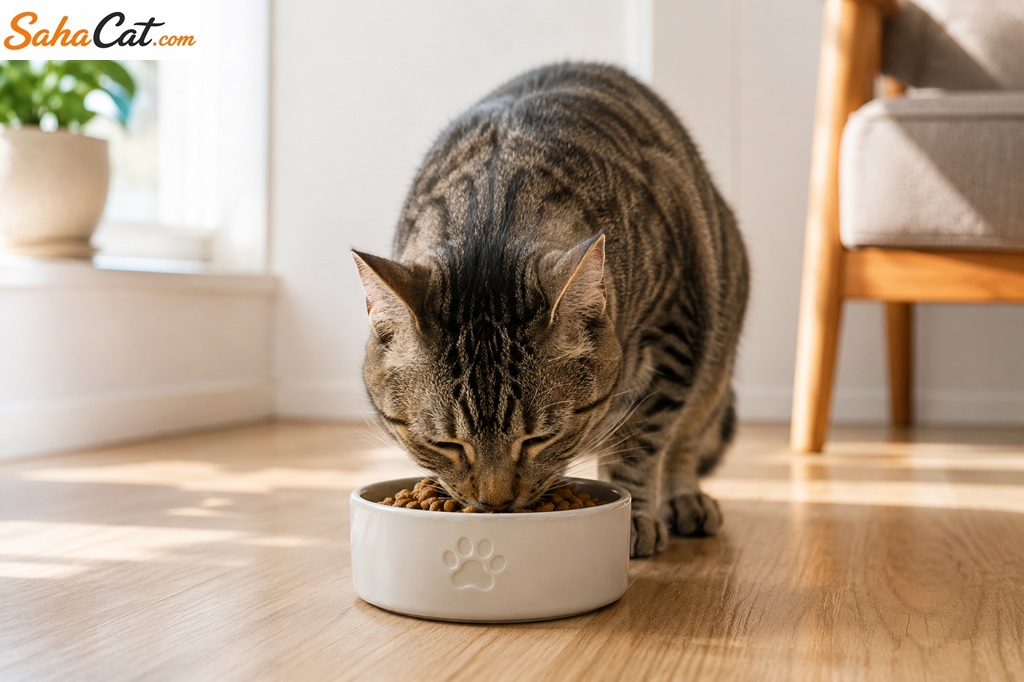
Dry food is generally cheaper per calorie, doesn’t spoil once left out, and works with gravity feeders and automatic dispensers — real advantages for multi-cat households or unpredictable schedules. Wet food spoils within a few hours at room temperature, costs more per calorie, and requires more frequent bowl cleaning, but offers the hydration and lower-carbohydrate benefits above. Neither format is a compromise across the board; the trade-offs run in different directions depending on what you’re optimizing for.
Format Matters Less Than Compliance — In Either Direction
Here’s a genuinely counterintuitive finding: a mineral-analysis study of commercial pet foods sold in the UK found meaningful non-compliance with European nutritional guidelines in both categories — and wet food actually showed a higher non-compliance rate than dry in that particular dataset, with issues like insufficient copper or excessive selenium in a notable share of products. The point isn’t that wet food is secretly worse; it’s that “wet” or “dry” tells you almost nothing about whether a specific product is properly formulated. A label meeting AAFCO or FEDIAF “complete and balanced” standards is a better quality signal than the format itself.
Special Cases Worth a Vet Conversation, Not a Guess
- Chronic kidney disease: increased moisture intake is a standard part of management, which is why vets frequently recommend shifting toward wet food or adding water to meals for cats with reduced kidney function.
- Diabetes or prediabetes: the lower carbohydrate load in most wet food is often specifically recommended, tied to the structural difference above, not a general wellness preference.
- History of urinary crystals or stones: higher moisture and a favorable starch-to-protein ratio are both directly tied to lower urine supersaturation for common stone types, per the 2024 study above — but the specific therapeutic diet matters more than simply switching formats.
- Multi-cat households with inconsistent supervision: dry food’s practicality (no spoilage, works with automatic feeders) is a legitimate factor, not a lesser choice, when daily wet-food monitoring genuinely isn’t realistic.
A Reasonable Middle Path
Mixed feeding — combining wet and dry — is a common and reasonable approach for owners who want some of the hydration and carbohydrate benefits of wet food without giving up the convenience of dry. There’s no rule requiring an all-or-nothing choice, and for a cat with no specific medical condition steering the decision, a mix is often the practical answer rather than a compromise.
The Factor That Matters More Than Wet or Dry
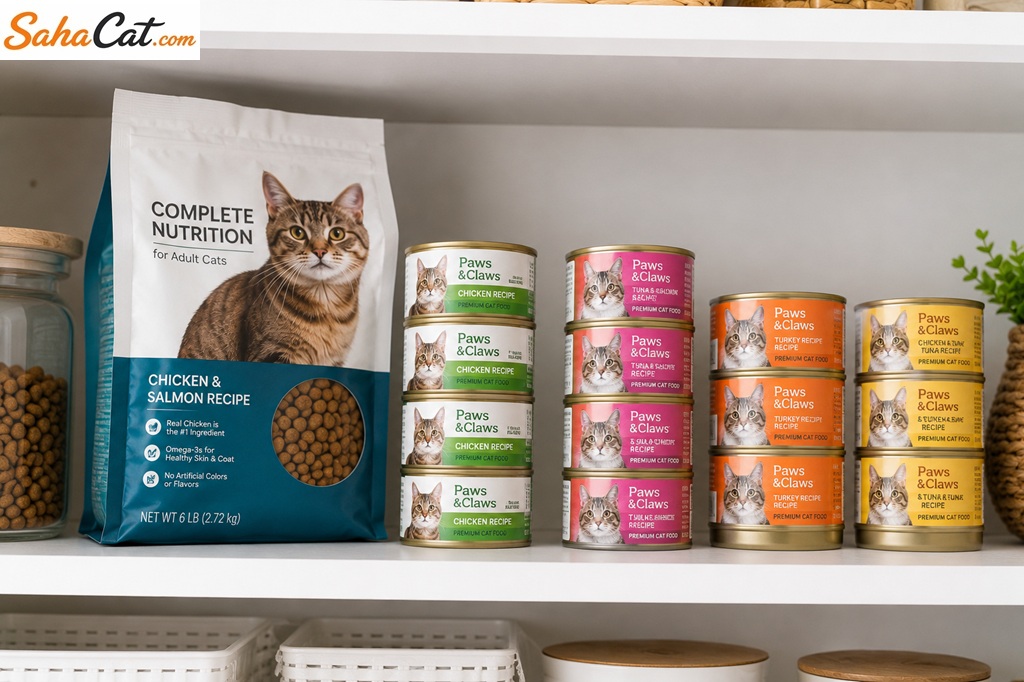
Everything above assumes a properly formulated food in either category — and that assumption isn’t automatic. A “complete and balanced” label meeting AAFCO or FEDIAF standards, appropriate for your cat’s life stage, matters more than which format it comes in. If your cat has a diagnosed condition — kidney disease, diabetes, a history of urinary stones, or significant weight issues — that conversation belongs with your vet before either format gets chosen on general principle.
Sources: WSAVA Global Nutrition Guidelines and WSAVA Global Dental Guidelines, World Small Animal Veterinary Association; Buckley CM, et al. “Effect of dietary water intake on urinary output, specific gravity and relative supersaturation for calcium oxalate and struvite in the cat,” British Journal of Nutrition, 2011; Tozato MEG, et al. “Starch to protein ratio and food moisture content influence water balance and urine supersaturation in cats,” PLOS ONE, 2024 (DOI: 10.1371/journal.pone.0315949); National Research Council (NRC) nutrient requirements data for obligate carnivores.
This article is for informational purposes only and does not replace professional veterinary advice. Any diet change for a cat with an existing health condition should be discussed with your vet first.
Last reviewed: September 2026